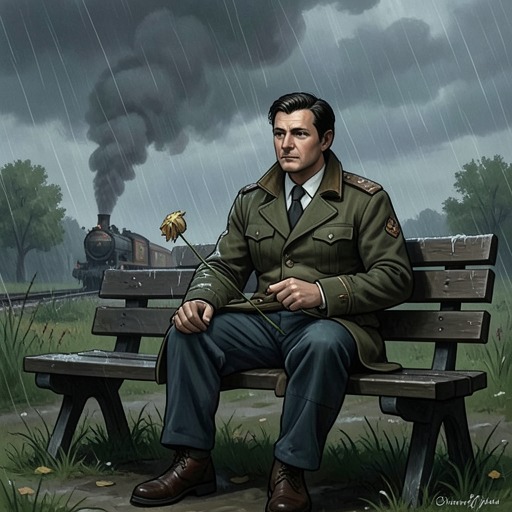
Spring
Norwegian WoodSpring in Norwegian Wood is not simply a season of renewal: it carries the promise of beginning again while sharpening the narrator’s awareness of illness, absence, and the demands of living on. Its meaning changes across the novel’s remembered landscapes and present-tense emotional crises. A letter about a possible life together, the arrival of cherry blossoms, and the loneliness of April and May make the season an active measure of what can be hoped for and what has been lost.
A season recalled and remade
Spring’s significance emerges within a narrative shaped by recollection. Looking back eighteen years later, Toru Watanabe can recover the details of an October walk in a meadow with Naoko: rain-washed green mountains, tall grasses moving in the breeze, and two red birds startled into the woods. At the time, he says, he was absorbed in himself and in the beautiful girl beside him, not in the scenery. The gap between the unremarked experience and its later vividness shows how memory can make a landscape meaningful after the fact.
The scene also demonstrates that recollection does not merely preserve what was visibly there. As Naoko spoke of a field well, Watanabe could not know whether it existed outside her mind. Yet afterward the imagined well became inseparable from the meadow in his memory. It belongs at the boundary between grassland and woods: a broad, unmarked opening, with damaged pale stones around its rim and darkness too deep to measure below. Spring, in this recollection, is not a pastoral refuge untouched by danger; remembered beauty is already joined to an image of hidden depth.
That retrospective pattern returns when autumn comes around again. After Naoko’s death, Watanabe understands each seasonal cycle as increasing the distance between himself and the dead. The seasons give time a visible rhythm, but that rhythm cannot restore what is gone. The novel’s spring scenes gain their force from this larger structure of recurrence: a season may return, while the people and circumstances bound to an earlier moment do not.
A possible beginning
In a letter, Midori Kobayashi imagines April as a good time to start something new and raises the possibility that she and Watanabe could begin living together then. She wants them to be near each other; if living together proves difficult, she offers another arrangement that would keep them in the same neighborhood. The proposal gives spring a practical, relational meaning. Renewal is not an abstract change in the weather but a question of how two people might make a life close to one another.
Midori’s suggestion remains open rather than coercive. She says that summer would also suit her if Watanabe preferred it, and asks him to tell her what he thinks. She is preparing to live alone and expects expenses for basic household things, so she plans to work extra hours to cover the cost of moving. She also hopes to visit him in Kyoto in March and asks which dates work. Her letter connects intimacy to planning, money, work, and ordinary domestic arrangements; a possible spring beginning depends on decisions still to be made.
Blossoms and grief
The spring landscape changes radically in the wake of news about Naoko’s condition. After reading a letter dated 31 March, Watanabe remains on a porch facing a garden where an old cherry tree is nearing full bloom. The soft light, breeze, and blossoms do not console him. As the afternoon darkens, he experiences the flowers as an image of wounds, and his thoughts turn to Naoko’s illness and to the question of why she has to suffer. The seasonal display becomes inseparable from his distress rather than a counterweight to it.
He draws the curtains, but shutting out the garden cannot shut out the season’s associations. Spring itself becomes an object of loathing because it brings back the ache and anticipates what he fears is coming. This reversal complicates the familiar association between blossoms and renewal: for Watanabe, their arrival intensifies the conflict between apparent natural flourishing and Naoko’s fragile health. The passage does not make spring the cause of his grief; it shows how grief takes hold of the season’s imagery and changes what it can mean to him.
The resulting isolation lasts beyond a passing reaction. Watanabe describes three days in which he feels cut off from other people, unable to communicate or receive their words fully. He stays inside, neglects ordinary care, eats what is within reach, and drinks whisky when sadness overwhelms him. The spring episode thus connects landscape to consequence: his aversion to the season belongs to a deeper withdrawal from the surrounding world.
April and May in isolation
Later, after Midori has told him she does not want to talk, April becomes a month of loneliness. Watanabe sees other people enjoying the warmer weather together, while the people who had mattered to him seem to have moved away from where he stands. He tries speaking to Midori but receives the same refusal, and notices her with other students. His isolation is sharpened by the contrast between the social ease he observes and his inability to join it.
May brings a different, bodily description of the same distress. As the sun goes down and magnolia fragrance hangs in the air, Watanabe’s heart swells, trembles, and hurts; the pain passes slowly, leaving an ache. At these moments he writes to Naoko. He chooses gentle subjects—grasses, a spring breeze, moonlight, films, songs, and books—and finds comfort when he rereads the letters himself. No reply comes from Naoko or Reiko. The letters therefore sustain a connection in the absence of an answer, while their deliberately pleasant contents offer Watanabe a temporary way to imagine the world as beautiful.
The season’s divided meaning
Spring gathers together incompatible possibilities. Midori’s letter makes April a time for closeness and a contemplated shared home; Watanabe’s memories and later distress make the same season a time of separation, anxious waiting, and grief. Blossoms can mark the advance of the year without promising recovery, just as the return of a season cannot return the dead. The contrast is not resolved into a single symbol: spring remains both an opening toward a future and a reminder that renewal does not undo loss.
The novel’s seasonal imagery is also inseparable from the act of narration. Watanabe’s account moves between a remembered scene, later reflections on memory, letters, and the immediate texture of his grief. The eighteen-year distance from the meadow makes the past newly legible, while the spring letters turn writing into a means of holding on to contact and ordering experience. Spring’s recurrence therefore works on two levels: it marks changes in the characters’ circumstances and exposes how the narrator’s understanding of those changes develops over time.